Vol. I · No. 13Bitcoin · RGB · USDTAll editions ↗
Frontier Field Notes
Tuesday, 3 November 2026Late edition · rehearsal issuePrice: 0.00 test USDT
USDT / SIGNET 1.00 testPUBLIC LAUNCH 28 NOVLIGHTNING Q1 2027LAUNCH PARTNERS UNPUBLISHEDISSUER UTEXO not TetherBACKING USDT0RETAIL MINT NO operators onlyMASTERCARD CPP SEAT not railsUSDT / SIGNET 1.00 testPUBLIC LAUNCH 28 NOVLIGHTNING Q1 2027LAUNCH PARTNERS UNPUBLISHEDISSUER UTEXO not TetherBACKING USDT0RETAIL MINT NO operators onlyMASTERCARD CPP SEAT not rails
USDT on Bitcoin, in rehearsal

Test money.

Utexo Mint opened on 22 October. Operators can mint, transfer and redeem USDT on Bitcoin - on Signet, where none of it is real. The real thing has a day: 28 November.

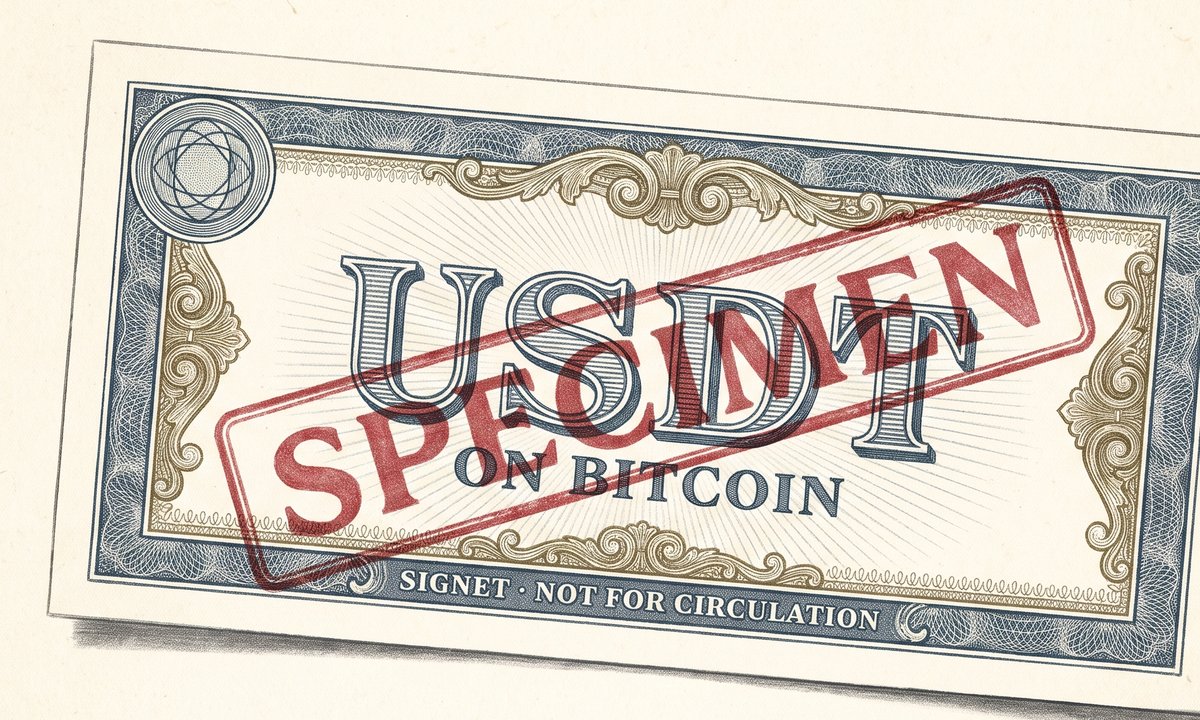
A banknote reading USDT on Bitcoin, Signet, not for circulation, with a red SPECIMEN overprint across it
SpecimenIn the banknote sense: printed to be inspected, not spent. That is what USDT on Bitcoin is for the next month.

Here is what is known: the day, the two phases - RGB on Bitcoin first, Lightning in the first quarter of 2027 - and that existing partners are preparing. Here is what is not: who they are. The launch-day partner list hasn't been published, so how many places will actually carry it on day one is still unknown.

Until 28 November it's test money. Then it isn't.

Two more details are worth holding. Retail can't touch the mint; ordinary users will meet this dollar only through the wallets and exchanges that integrate it. And the compliance story is specific: incoming USDT is screened, anti-money-laundering scores are checked, and Crystal Intelligence is the named partner for monitoring risk on the RGB side.

Test money is the right name for this month, and only this month. On the 28th it stops being a rehearsal. The test that has run through the whole series doesn't change - how many places you already keep money can hold it - but for the first time, there will be an answer to check.

The rehearsalwhat a test dollar goes through · on Signet
STEP I

Mint

An operator deposits, Utexo issues

A verified operator - an exchange, a wallet, a market maker, an OTC desk - sends USDT in. Utexo Mint issues the Bitcoin version against it. The backing runs through Tether's USDT0 protocol; the issuer on Bitcoin is Utexo, not Tether.

retail cannot mint directly
STEP II

Transfer

It moves privately, on RGB

The transfer is validated client-side by the parties to it. Only a commitment reaches the Bitcoin chain; the amounts and the counterparties don't. This is the step everything else in the series has been about.

confidential by default
STEP III

Redeem

The operator burns, the backing returns

Redemption runs the other way: the Bitcoin-side USDT is burned and the USDT behind it is released. On Signet, every one of these is pretend money - which is the point. It's the same round trip, with nothing at stake.

rehearsed on Signet first
Page 2 · The roomMastercard Crypto Partner Program
A long conference table crowded with faint figures, one empty chair pulled out with a brass plaque reading UTEXO
A seatOne new chair at a table of a hundred-plus: Binance, Circle, Ripple, PayPal, Paxos among the others.

The network No. 10 compared it to.

A seat at the table, not a connection to the rails. Both are true.

No. 10 made one argument: that Lightning's value was never speed but the execution-settlement split Visa and Mastercard built their networks on. On 21 October, Mastercard let Utexo into its Crypto Partner Program. It is a pleasing loop, and it needs reading carefully.

The program launched in March 2026 and now counts more than a hundred members - Binance, Circle, Ripple, PayPal, Paxos among them. Participants work with Mastercard teams on the design of future products: cross-border payments, B2B transfers, payouts, settlement. It is a forum. It is not a connection to the card rails, and nothing announced says Utexo payments now run through Mastercard.

What it is, is access - a seat in the room where a card network is deciding how stablecoins fit the rails it already runs. For a settlement layer that only wins through integrations, that is the right room. Whether the seat turns into distribution is the question, and it won't be answered this month.

Analysisthe fine print behind the phrase

Bridged, not native - and it says so.

Launched by Utexo, not by Tether. Backed through USDT0. Said out loud.

The word coming home invites a picture of Tether minting dollars directly onto Bitcoin. That is not what is launching, and Utexo has been unusually direct about it: USDT on Bitcoin is launched by Utexo, not by Tether. Utexo Mint is not owned or operated by Tether. The asset is backed by USDT through Tether's own USDT0 protocol.

So the honest description is a bridged dollar - lock on one side, issue on the other - with Tether's name on the backing and Utexo's on the issuance. No. 08 walked through exactly this shape, and the questions it raised still apply: who holds the collateral, what the federation is for, what happens when an asset is lost on the RGB side.

None of that makes the thing worse. It makes it a specific thing rather than a slogan, which is the only version worth testing. Test money, in the most literal sense: a dollar whose plumbing you can see, rehearsed on a network where none of it is real yet.

October in brieffive more things
ONLINE 14 Oct - An X Space on what USDT on Bitcoin changes, hosted with RGB Hub, Bitlight and others - the conversation side of a launch, a week before the infrastructure side.
ONLINE 16 Oct - UniSat sketches a roadmap: USDT as a shared currency for trading Bitcoin-native assets, plus payments and agentic use. Still no date of its own.
TURIN Oct - The RGB Protocol Association runs an Agentic Dollars on Bitcoin hackathon, sponsored by Tether and Utexo. Utexo's CTO sits on the jury.
LUGANO 24 Oct - Mint and redemption are shown live on Bitcoin at Plan B, at an event hosted by Blockstream Capital Partners and BFX Securities.
ONLINE 26 Oct - A troll account invents a story about Utexo and the IRS. Utexo calls it fake. Launches attract this; that is not a reason to ignore it.